Posts

Showing posts with the label NFV

Demystifying SDN: SDN via APIs

Image
In my previous blog, I explained the basics of Software Defined Networking (SDN), how SDN has evolved to this point, the separation between the control plane and data plane, plus we named the three main flavors of SDN: Open SDN, SDN by APIs and SDN via overlays. We also covered the principles of the first approach, Open SDN. In this blog, I will cover the implementation of this technology via APIs, a preferred method used by traditional networking hardware companies. SDN implementation via APIs refers to southbound APIs that configure and program the control plane active on the device. There are a number of legacy network device APIs in use that offer different degrees of control (SNMP, CLO, TL1, RADIUS, TR-069, etc.) and a number of newer ones (NETCONF/YANG, REST, XMPP, BGP-LS, etc.) that offer different degrees of control over the network devices, data plane, topology, etc., each having different advantages and disadvantages. I won’t cover them in depth...

Demystifying SDN: Open SDN Approach

Image
Demystifying SDN: Open SDN Approach By Javier Guillermo  - Principal Consultant - September 16, 2017 The joke goes around that the true meaning of Software Defined Networking (SDN) is “Still Don’t Know”.  In short, SDN is a technology that allows network administrators to no longer be reliant on static architecture of traditional hardware/networks, but freed to centrally and dynamically manage the network via open, programmatic interfaces.  This is accomplished by separating the control plane (the system that decides where the network traffic will go) from the data plane (the systems that forward the traffic onto their destination). Software Defined Networking (SDN): Business Drivers What’s driving the need to change from the transitional method of managing networks and move towards a SDN approach?  There are three key catalysts in the industry driving the need for network change as show in the graphic below. Mobility, cloud, and IoT...

Out with ECOMP and Open-O, in with ONAP - Battle for Open Orchestration

Image
For quite sometime, there hasn't been any real standard for MANO-NFV Orchestration and Automation, granted that there are plenty of excellent proprietary solutions but there wasn't a real open Source reference architecture on this regard.  Somewhere around 2015, two main initiatives where created: ECOMP and Open-O. ECOMP was part the Domain 2.0 initiative which goal was to virtualize up to 75% of AT&T network by 2020 by leveraging cloud technologies (AIC, AT&T integrated Cloud) and network virtualization while reducing CAPEX and achieving operational  The main issue was that there was no playbook to follow for virtualizing and software-controlling a Wide Area Network, ECOMP was the biggest software project to AT&T to date, tasked to address these key issues. It stands for Enhanced Control, Orchestration, Management and Policy . ECOMP is an infrastructure delivery platform and a scalable, comprehensive network cloud service.  It provides automation of ...

AT&T FlexWare thoughts

Image
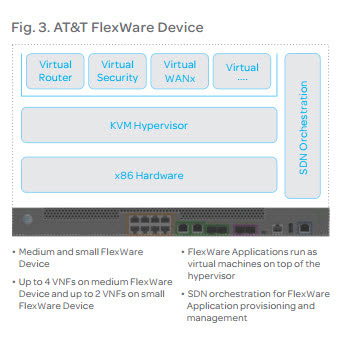
FlexWare is AT&T's latest offer for NFV (Network Function Virtualization) targeting software control of VNFs for enterprise customers. One of its greatest advantages is its multi-vendor approach, as It is offered in conjunction with AT&T VPN service and supports Juniper and Cisco virtual routers, Fortinet virtual security, and Riverbed virtual WAN accelerator. These AT&T-certified FlexWare Applications can be deployed on either small or medium industry standard FlexWare Devices and come with flexible AT&T or customer management options. According to Roman Pacewicz, SVP &T Business,   In less than 2 years, AT&T has been deployed to more than 2,000 sites globally, expanding to over 200 countries and territories. Orchestration is going to be done through IBM's cloud, cognitive, analytics and security infrastructure. AT&T can install an FlexWare Device on your premises, bring it online and manage it, just as we would a traditional managed network...